

Changelog
Dec 19, 2025
(PART 1 of 5) The Night the Phones Wouldn’t Stop Ringing (and What It Teaches About Revenue Today)

“When demand shows up after hours, your business either answers… or it doesn’t.”
If you run an appointment-based or inbound-lead business, you’ve lived some version of this:
It’s after hours. You’re finally off. Then the phone lights up—once, twice, then again. You don’t answer because you can’t. You tell yourself, “If it’s important, they’ll leave a voicemail.”
They do. And they also call the next business on Google.
That’s the real story behind “missed calls.” It isn’t a phone problem. It’s a revenue accounting problem. Every inbound call represents paid-for intent—paid with ad spend, reputation, time, or referrals. When you don’t answer, you don’t just lose that job. You lose the acquisition cost behind it, and you train the market to buy from someone else.
What voice agents change is simple: speed-to-lead becomes infrastructure.
Instead of relying on heroics (“Someone grab the phone!”), you build an always-on front door:
Answer immediately (24/7 if you want it)
Identify intent fast (book / question / urgent)
Move the caller to an outcome (appointment booked, routed to a human, or confirmed callback)
Capture structured details so your team doesn’t start from zero
This is not a “cool demo.” It’s a conversion mechanism.
Why it matters: customers are impatient by design
Customers don’t call “to chat.” They call because they’re ready to decide. Industry research consistently shows that hold times and slow responses increase abandonment, and that many customers prefer a scheduled callback to waiting on hold. The takeaway is operational: reduce delay, reduce drop-off.
A modern voice agent’s job isn’t to sound like a human. It’s to behave like a competent receptionist:
Clear opening menu (“book / question / urgent”)
Confirmation loops (name, number, time, address)
Fast time-slot offers (2–3 options max)
Immediate SMS confirmation
Human handoff when the situation calls for it
The “front door” is the funnel
In most SMBs, your funnel isn’t your website. It’s your phone line. When voice agents cover that front door, you stop leaking revenue at the highest-intent moment.
Practical implementation checklist
If you’re considering voice agents, start with these:
Define outcomes per call type (book / route / answer + follow-up)
Build a tight knowledge base (hours, policies, service area, pricing ranges)
Set escalation rules (urgent, emotional, complex)
Connect to the calendar + CRM so calls create real work automatically
Track the metrics that matter (book rate, abandonment, speed-to-lead, escalations)
Bottom line The businesses that win in 2026 will not be the ones “using digital agents.” They’ll be the ones operationalizing responsiveness—turning inbound intent into booked outcomes automatically.
(PART 2 OF 5 ) The Cost of a Conversation: Why Voice Agents Are Becoming the Base Layer of Customer Ops

“The same demand can either exhaust your team… or flow through a system.”
Most owners evaluate voice agents with one question: “What does it cost?”
The better question is: “What are conversations costing me today?”
Because the majority of inbound calls in most SMBs are not complex sales calls. They’re operational repetition:
Hours and location
Service area
Pricing ranges / “how much does it cost?”
Reschedules and cancellations
Status checks
“Can you come today?”
When a human answers these repeatedly, you pay in three currencies:
Labor minutes
Cognitive load (context switching)
Opportunity cost (the work you don’t get to do)
Voice agents reduce cost by removing the “clipboard layer”
The clipboard layer is the manual translation step:
Call happens → human takes notes → human re-enters into calendar/CRM → human sends confirmation → human creates follow-ups
That’s not “service.” That’s administrative glue work.
A well-designed voice agent turns conversation into structured action automatically:
Books the appointment directly
Updates CRM fields
Sends SMS confirmation
Creates a ticket or task
Produces a summary for the team
Humans are still essential—but their role shifts
This is the actual ROI model I’ve seen work consistently:
Humans handle high-emotion, high-complexity, high-value cases
Voice agents handle repetitive intake, scheduling, FAQs, and routing
That frees your team to do the work that improves retention and upsell:
Follow-ups that close leads
Proactive service communication
Quality control
Customer recovery (when something goes wrong)
How to model ROI without wishful thinking
Use this simple structure:
A) Deflection savings = (FAQ calls) x (avg minutes) x (loaded labor rate)
B) Handle-time savings = (human-touched calls) x (minutes saved from pre-captured context)
C) Abandonment reduction = (calls saved from hangups) x (close rate) x (avg job value)
Even modest gains in these areas often cover the cost quickly—especially if after-hours coverage is currently “owner on call.”
Bottom line
Voice agents aren’t replacing staff. They’re removing repetitive front-desk work so staff can do higher-value work—and so your business can cover demand without scaling chaos.
(PART 3 OF 5 ) “Human-Like” Voice Agents: Why the Goal Isn’t a Perfect Voice—It’s a Professional Experience

“Human-like isn’t a voice. It’s a feeling: ‘I’m being helped.’”
Most voice agent projects succeed or fail on one factor people underestimate: conversation design.
“Human-like” isn’t about pretending to be human. It’s about delivering the experience of a competent receptionist:
Fast
Clear
Respectful
Confident when it knows
Honest when it doesn’t
Quick to escalate when needed
The 7 design rules that prevent “robot conversations”
Start with a narrow menu
“Book / question / urgent” beats “How can I help?” every time.Confirm critical details
Name, phone, address, appointment time. Confirmation is trust.Use progress markers
“Got it. One quick question. Here are the next times.” This reduces anxiety.Keep choices small
Two or three time options. More creates decision fatigue.Don’t bluff
If the answer isn’t governed, escalate. Never invent policies.Build an escape hatch
Let callers ask for a human easily. Don’t trap customers.Design recovery
When the agent mishears, it should clarify gracefully, not insist.
A practical definition of “human-like”
If callers say:
“That was easy.”
“Someone answered right away.”
“I got scheduled quickly.”
…then your voice agent is “human-like,” regardless of whether the voice is perfect.
Bottom line
Conversation design is product design. You’re not “installing AI.” You’re building a new front desk experience.
(PART 4 OF 5) Voice Agents as Workflow Engines: The Conversation Is Not the End—It’s the Trigger
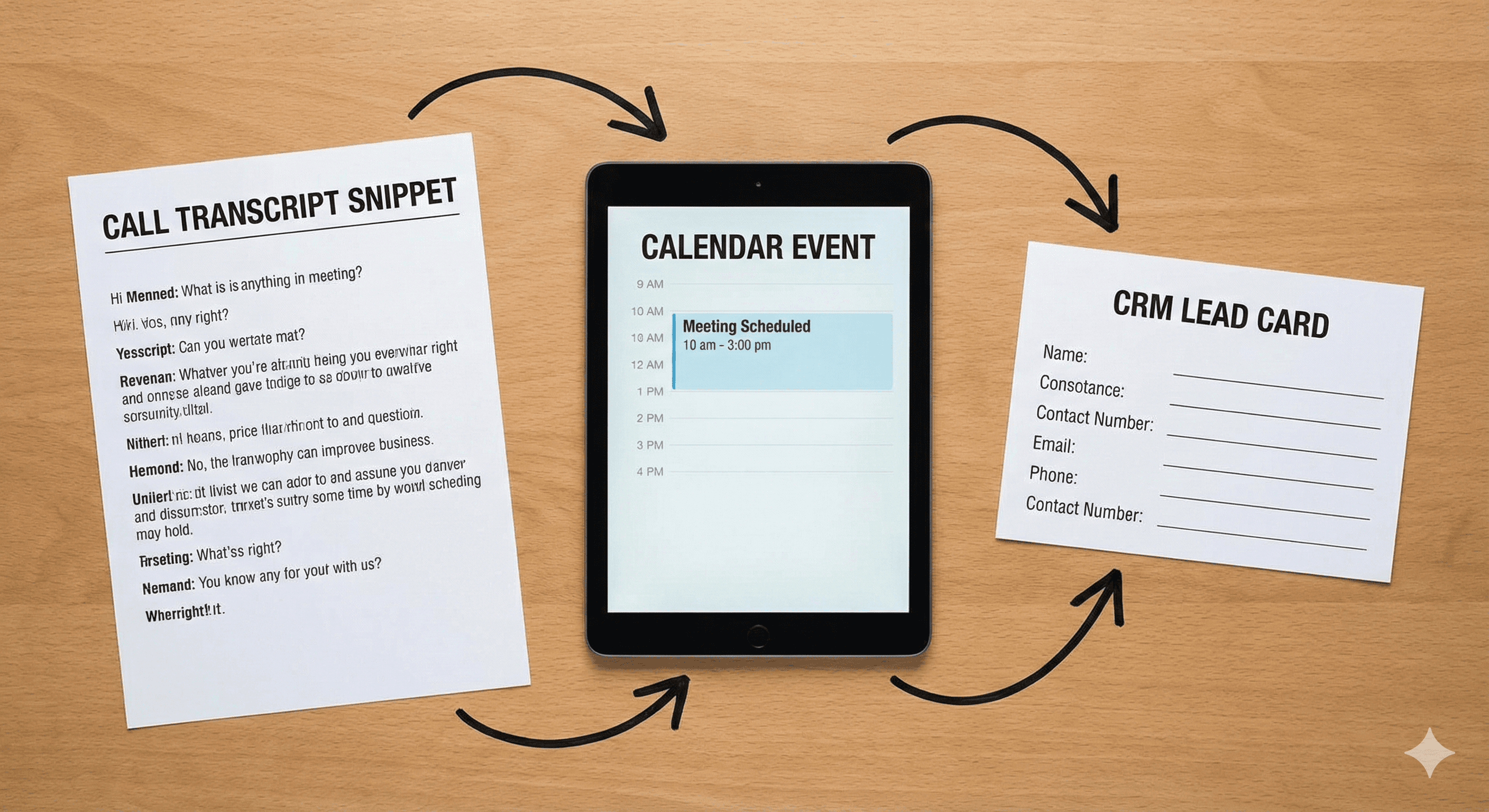
“The phone call is no longer the end of the process. It’s the start.”
The most valuable shift happening right now is this:
Voice agents are moving from “talking” to “doing.”
If your voice agent isn’t connected to your systems, it’s just a nicer voicemail.
If it is connected, it becomes a workflow engine:
Calendar booking/rescheduling
CRM record creation and enrichment
SMS confirmations and reminders
Lead routing to sales
Ticket creation for ops
Post-call summaries and next-step tasks
This is what removes operational drag
The goal is fewer handoffs, fewer re-entries, fewer “What did the customer say again?”
When the agent captures structured data once, everything downstream becomes smoother:
techs show up with the right notes
sales calls start with context
admin work shrinks
customers stop repeating themselves
Implementation sequence that avoids chaos
Stage 1: Answer + route + capture details
Stage 2: Booking + confirmations + reminders
Stage 3: CRM enrichment + follow-up automations
Stage 4: Optimization (analytics, QA, specialized flows)
What to measure
Booking rate
Abandonment rate (hangups before resolution)
Speed-to-lead (time to next step)
Escalation rate (and reasons)
No-show rate (before/after reminders)
Customer sentiment indicators
Bottom line
A voice agent should not be a “conversation layer.” It should be an “execution layer.”
(PART 5 OF 5) Governance Is the Differentiator: How to Deploy Voice Agents Safely

“The most powerful agents are the most governed.”
As voice agents become more capable, the biggest competitive advantage won’t be capability. It will be reliability.
Reliability comes from governance.
What governance means in practice
A defined “allowed actions” list (book, reschedule, answer FAQs, route urgent calls)
A defined “not allowed” list (diagnose, promise pricing outcomes, negotiate policies)
Approved knowledge base sources (policies, hours, service area, pricing ranges)
Consent rules (recording/transcription disclosure and opt-out paths)
Escalation triggers (high emotion, safety, sensitive topics, explicit human request)
Audit logs and monitoring (what happened, why, and how to improve)
The most common failure modes I see
The agent “sounds good” but can’t complete actions
The agent can act, but has weak guardrails and invents answers
The agent captures data, but it isn’t structured or routed properly
The business doesn’t review calls, so errors persist and trust erodes
How to operationalize governance
Weekly reviews in the first month
Monthly governance updates thereafter
A living knowledge base with an owner
A call sampling process (both good and bad calls)
Metrics tied to outcomes, not novelty
Bottom line
Voice agents are becoming a base layer for customer operations. The winners will scale the system with guardrails, measurement, and continuous improvement.
Changelog